
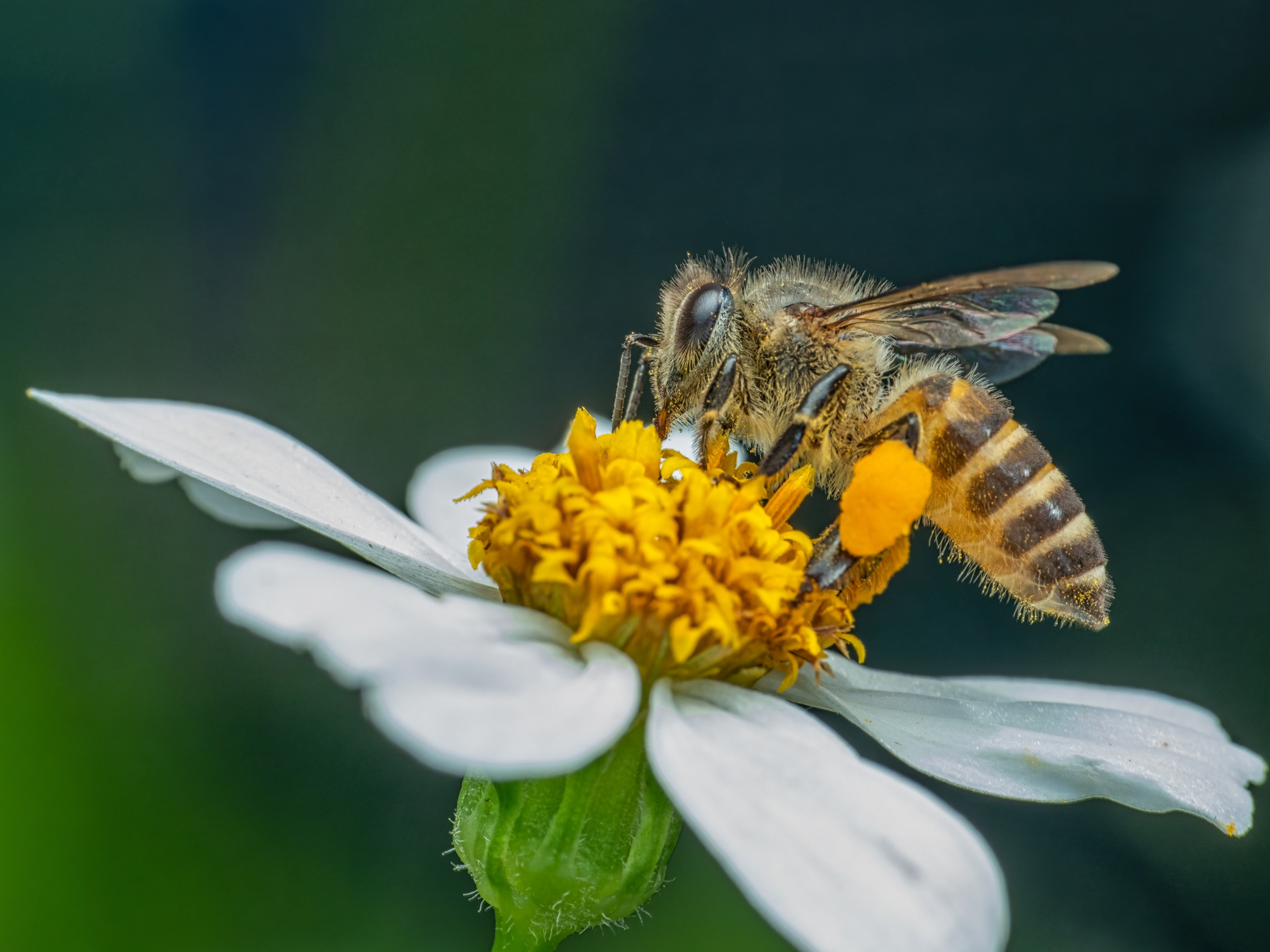
In the mini overview of this new series, The Buzztastic Bee, I told you that there are 20,000 species of known Bees in the world, which is a lot of Bees. Fortunately, all 20,000 of these Bee species fall into seven distinct families, and it is these families I will introduce you to today! But before that…
What is a Bee?
This might seem like a silly question, but with 20,000 different types of Bees, it certainly doesn’t hurt to ask. Contrary to popular opinion Bees are not solely insects that make honey; instead, they are defined as a winged, hairy-bodied insect that feeds on the nectar, pollen, or floral oils of flowers.

They are one branch of the Hymenoptera family, a class of insects that includes Wasps, Ants, and Sawflies, and range vastly in size and colour. They are closely related to Wasps, with the main differences being their appearance, the way they raise their young, and their behaviour. Bees are hairy for carrying pollen and tend to be stockier than their Wasp cousins, whereas Wasps are slender-bodied and hairless with narrow ‘waists’ that connect their abdomen to their thorax.
Wasps are also predatory and will feed their young other insects, whereas Bees will feed their young the pollen they collect. When it comes to stinging, Bees have barbed stingers and are only able to sting once, and will typically only do so when their hive is threatened, whilst Wasps have smooth stingers and can sting multiple times and tend to be more aggressive than Bees.
Despite their differences, Bees and Wasps are so closely related that they can still be really difficult to tell apart, with some Bees looking more like Wasps than the familiar image of a fuzzy Bee. This is understandable as Bees actually came from Wasps, and with so many species, some, like the Cuckoo Bee, still look like their Wasp cousins. In fact, most nomadic bees (which are what Cuckoo Bees are) look like Wasps, which brings us to the seven distinct families of Bees.
The Seven Bee Families

The seven Bee families are:
- Apidae
- Halictidae
- Megachilidae
- Andrenidae
- Colletidae
- Melittidae
- Stenotritidae
Quite the mouthful, aren’t they? Don’t worry, these Bee families fall into three easy-to-remember categories:
- Short-tongued
- Medium-tongued
- Long-tongued
Short-tongued Bees

Andrenidae – Commonly known as Mining Bees, these typically dark-coloured Bees are solitary and nest in simple burrows. They are relatively small (around 10-20mm) and live in temperate climates from North America to Europe. They are one of four Bee families that contain crepuscular species, which is a term given to any animal that is most active at dawn and dusk.
Colletidae – These Bees are often called Plasterer Bees because they smooth the walls of their nests with a special secretion from their unique two-part tongue that dries into a cellophane-like material. They are mainly found in Australia, though their range does spread to North America, South America and some parts of Europe. Unlike other Bees, they carry pollen in their stomachs and regurgitate it instead of carrying it on their legs or bodies.
Stenotritidae – These Bees are very similar to the Bees of the Colletidae family, with the key difference being that they have a one-part tongue instead of two. They are the smallest family of Bees, and all live strictly in Australia (commonly known as Australian Mining Bees). They are large, fast-flying Bees that live in underground nests ranging from shallow burrows to burrows three metres deep. Like their Colletidae relatives, they have Ocelli eyes (simple eyes), which are large and help them see well in dimly lit spaces.
Medium-tongued Bees

Melittidae – This family of Bees is the most closely related to Wasps and is found strictly in the African continent. They are small to moderate-sized Bees that are completely solitary and nest in burrows. Within the Melittidae family are the Macropis Bees, commonly named Oil Bees because they are specially adapted to collect the oil of flowers – a good example is the Common Loosestrife Oil Bee. The females have spongy hairs on their hind legs that are well-suited to mopping up flower oil, which they then use to feed their young and waterproof their nests.
Halictidae – These Bees, especially the smaller species, are commonly known as sweat Bees because they are attracted to perspiration. Most species are quite pretty, often coming in shades of metallic green, metallic blue, and copper. They too nest underground, typically burrowing in sand or soil. The social dynamics of the Halictidae family are vast, with some living in highly social nests not too dissimilar from a hive and others who live solitary (though even solitary Halictids may share the entrance of their nest with other Bees).
Long-tongued Bees

Megachillidae – This family of Bees includes Orchid Bees, Leaf-cutter Bees, and Mason Bees, and as their name suggests, they are relatively large. They are named after the things they use to build their nests, though many still nest underground or in hollow trees. Unlike other Bees who carry pollen on their legs, they carry pollen in a specialised structure on their belly called a scopa. This limits the amount of pollen they can carry; however, this does not limit their ability to pollinate plants. Many Megachillidae species will vibrate their bodies when visiting flowers to shake the pollen out of them, therefore covering their bodies in pollen due to their fast-paced foraging style. Not only do they visit multiple flowers, but they also drop the pollen covering them as they do so, which has led them to be known as super-pollinators.
Apidae – Last but not least is the largest of the Bee families, the Apidae family. This family includes Bees you are very familiar with, such as the Honey Bee and the Bumblebee and Bees you may not be so familiar with, such as the Cuckoo Bee. This Bee family is unique in that it includes a subfamily of stingless Bees, such as the Royal Lady Bee, which are native to Mexico. Apids range from social to solitary, with some, like the Cuckoo Bee, known to be parasitic as it lays its eggs on the pollen of its host Bee. Out of the 5700 species, only 7 of them are Honey Bees.
Andddd that’s it! That’s the seven families of Bees. Did you know there was such a wide range of Bees? Did any of their behaviours, lifestyles, or appearances surprise you? Why not talk about it with a friend or family member, or look even deeper into this beeriliant insect family because there’s so much more to uncover! For us today, though, this is where we stop, but don’t worry, because next week we continue with our Buzztastic Bee series as we look at why our furry flying friends are so important to us and the planet. See you then, Little Stewards!